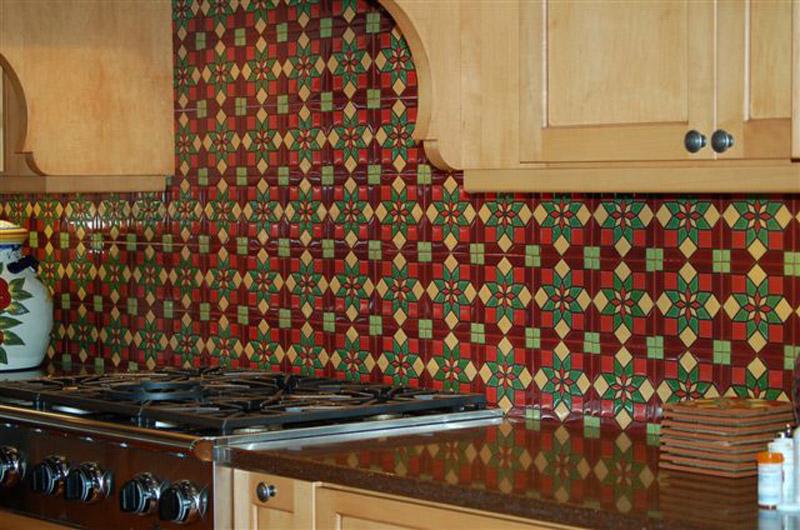
 If you visit an old village showing homes from the 1800s and early 1900s, you’ll notice that certain homes obviously had more money than others by the way they were decorated. To have wallpaper, carpeting and/or decorative tiles in the old days meant the family was affluent. Today, we are fortunate that the majority of people can afford all of these things in their own homes if they want them.
Hand painted ceramic tile art and murals go back centuries as one of the oldest art forms known to mankind. Carolyn Payne of Payne Creations in Kansas City has been creating beautiful decorative tiles since the 1980s and her work is seen in many places, from public shopping centers to, possibly, your neighbor’s house.
What are some of the best places for decorative tiles? These days, it’s all about the kitchen backsplash. This is an area of the house that gets looked at, a lot, and most homes don’t have any decoration for their backsplash. Therefore, decorative tiles add some much needed ambiance to the room. Sure, you could go with store-bought tiles that all look the same, but there’s something special about hand painted tiles done by an artist specifically for you that makes what Payne Creations does especially unique. With your input, Carolyn can create a tile mural offering vibrant colored glazes with texture and detail to delight all those who see it. Her hand painted tiles can be shipped to your location with layout instructions for the installer.
Meanwhile, decorative tiles can also be found in other rooms in a home. Bathrooms and living rooms are two places where they can be seen and enjoyed by many people. It’s not unusual for showers in bathrooms to include decorative tiles. They can also be placed around fireplaces in living rooms, highlighting what could otherwise be a somewhat dull and pedestrian fixture.
To discuss decorative tiles with Carolyn Payne of Payne Creations, please call 816-452-8660 today.
]]> You can tell a lot about a person by walking into their home and looking around to notice the carpeting, furniture, paint colors, and objects of art (or lack thereof) around the rooms.
Home décor matters. It helps show others who you are and what you’re interested in. It’s also a way to surround yourself with things you like that make you feel good living there. Style is all around us; why not make our homes look a way that reflects our own personal style, right?
Recently, a little girl visited a house and upon seeing the living room exclaimed to the adult, “Are you rich?” Interestingly, the room was decorated with items from discount stores and garage sales, yet it had the appearance of affluence. When the arrangement of objects in a room is done well, and there are unique and colorful things to look at, chances are visitors will be impressed. It’s always nice to have visitors comment that they “love what you’ve done with the place,” isn’t it? People want to be proud of their homes and show them off.
Payne Creations helps decorate homes with gorgeous hand painted ceramic tile art and murals. These artistic pieces garner much praise from homeowners and visitors alike. Adding hand painted ceramic tile art to key places in a home, such as the kitchen backsplash, can really make a place “stand out” from other homes. In addition, Payne Creations is able to utilize designs distinctively personalized to the homeowner’s desires. People are unique, so the artwork in their home should be, too.
If you’ve been thinking about improving and/or updating your home décor so your home looks its best, consider hiring Payne Creations to help give you artistic looks like you see in Better Homes and Gardens, House Beautiful, and Country Living— all of which Payne Creations’ work have been featured in! Call 816-452-8660 to discuss dynamic home décor ideas today.
]]>It’s a tragic circumstance when a community thinks that it would be better to pulverize an artwork that took someone years to create rather than accommodate that piece into new construction or a new setting. For example, this article published by the British newspaper The Independent reports the decision of the governing body of a small city in Wales to allow the destruction of a tile art mural that depicts a major skirmish that claimed dozens of lives more than 150 years ago.
The Welsh city of Newport announced in early October that a 115-foot mural depicting the Chartist uprising at the city’s Westgate Hotel in 1839. During that battle, 5,000 Chartists, reformers looking for political reform for the working class, marched on the hotel under the belief that fellow Chartists were being held hostage there. The mural, installed in nearby John Frost Square in 1978 by artist Kenneth Budd, contains nearly 200,000 glass pieces and displays a chaotic scenes of militiamen marching on the hotel with pitchforks and guns, surrounded by clouds of smoke.
Instead of spending £600,000 to move the mural for an entire mall construction project with a budget of £100 million, Newport has decided to raze the artwork to make way for the shopping center. Destroying a public work of art like this isn’t just sad; it’s a threat to the very notions of democracy. Tile art is meant for everyone to enjoy, unlike a retail establishment that only caters to those with enough income to frequent the store.
Payne Creations enjoys creating works of art that can be enjoyed by all who have eyes to see. Whether you have a public space in need of a splash of creativity, or you want an artistic reimagining of a wall in your own home, we can bring interesting and compelling designs to your living space that you will enjoy for years. Remember, tile art IS democracy!
]]> Nietzsche famously wrote, “Art is the proper task of life.” Is Nietzsche correct in this assessment? Is the sole purpose of life to create art? Maybe, maybe not…
What we do know for sure is that art is certainly therapeutic, as many artists enjoy a cathartic release while working on a particular project. Many go to art galleries and museums as a way to cope with the rigors of reality, the harshness of a debt-fueled world. Art in any capacity, be it music, the stage or the canvas, can be THE thing that pulls someone out of the darkness and into the light, from the deathbed and into the ballroom.
Art’s therapeutic qualities are well known amongst artists and appreciators, but hospitals nationwide are embracing it wholeheartedly, with more than half of them having Arts-in-Medicine programs or artists that are on-call. The creative arts may be able to treat patients whose pain cannot be alleviated by pills and medical procedures. One such program is The University of New Mexico Arts-in-Medicine Program (AIM), based at the University of New Mexico Hospitals (UNMH), the oldest university-based arts programs.
In the article, “Helping patients heal through the arts,” Amanda Gardner of CNN.com describes AIM. She writes, “A troupe of actors, dancers, writers, musicians, visual artists and movement specialists rove the different sections of the hospital. Painters might be found on any given day in the cancer center, dancers in the psychiatric unit and harpists providing musical sustenance on any given floor.”
These artists are a roving band of health-facilitators, encountering patients in every hospital room, every floor, and helping speed up the recovery process. Whether you are an actor, dancer, writer, musician, visual artist or movement specialist, Arts-in-Medicine can use you and your unique skillset.
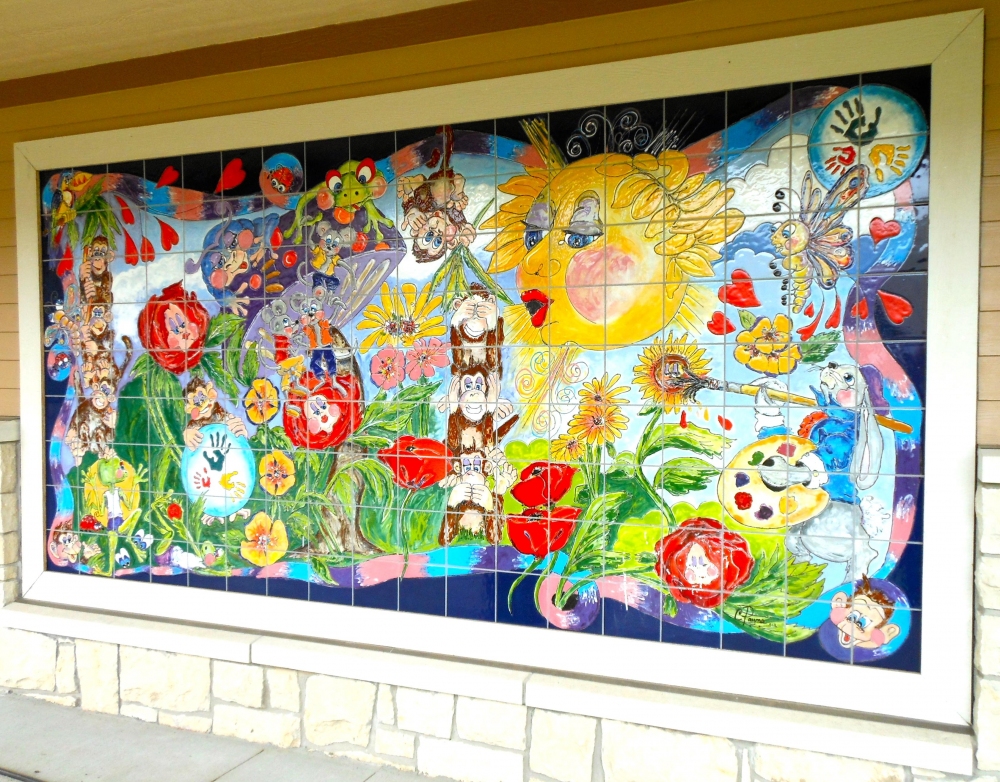
The New Mexico group has helped a variety of patients, including a painter paralyzed from the neck down. She was designated by the hospital as a problem patient who had given up hope. This is not too shocking; she lost the ability to paint, the activity that drove her soul. To help with her recovery, an artist volunteered to paint for her, to act as her hands. The paralyzed woman dictated the drawing and the painter did as directed. The process reinvigorated the patient’s hope and optimism. The next day, she was a completely different patient! Art heals; it is simple as that.
For over 28 years, I have been creating beautiful hand painted ceramic tile art in Kansas City. Given my experience doing installation pieces for children’s playground areas, public community centers and hospitals, I have seen firsthand the benefits that art has on the soul. Art is indeed THE thing that can pull someone out of the darkness and into the light, from the deathbed and into the ballroom.
–Carolyn
Source: http://www.cnn.com/2013/07/05/health/arts-in-medicine/index.html
*First image courtesy of Alexander Raths
]]>In the article “Carving out a place in history: tile carvers put traditional craftsmanship first”, Zhang Wen of Global Times writes, “Many people started to take notice of this traditional art form when Zhang was requested to carve tile walls for the 2008 Beijing Olympic Village.” The article focuses on Zhang Yan, a Chinese artist who works with bricks, carving serene images into them – including flowers and mountains.
 Zhang comes from a long line of tile carvers. It is a family tradition. He takes pride in continuing the traditional art form of both his family and country. Each carving is a lengthy process. One must be patient and never anxious. Zhang has 20 apprentices! They work together, repeatedly redefining the tile’s surface. It is a quest for perfection. It is also a quest to better a city and country. Business is good for Zhang. He is making money all while preserving Chinese tradition. Many of his carvings are scattered throughout Beijing, on residential properties as well as businesses. That, I feel, is one of the biggest strengths of tile art. Like moths to a flame, eyes naturally drift toward tile art.
As Jorge Selaron revitalized a dreary and drab part of Rio de Janeiro and illuminated the inherent vividness of the city, Zhang is staying true to tradition while making it a part of modernization. Sometimes an artist becomes so synonymous with a town or city that he or she becomes indistinguishable from the identity. Selaron certainly was and Zhang is as well.
Tile art is personal, but its biggest strength is how it affects and transforms the public sphere. An installation, for example, can honor the victims of a tragedy or it can reinforce a hospital’s mission statement. It can help makeover a city block by beautifying a wall and showing the potential for the block and the city as a whole. Tile art reminds one of tradition and unites hearts in common cause. It, in other words, thwarts the totalitarianism of feeling and frees up a city.
For more information on Zhang Yan, look here.
*Image courtesy of Peter Griffin
]]> I am a railroad worm burrowed in a juicy Macintosh. If you haven’t figured it out, I am currently on vacation in NYC!
The city, it seems, is the capital of tile art. It is everywhere, particularly in the subway. Many of the art pieces are commissions courtesy of the MTA Arts for Transit program and seen by hundreds of thousands of city-dwellers and tourists. Such pieces are in the New York City Transit, Metro-North Railroad, and Long Island Rail Road.
The MTA website states, “As the MTA rehabilitates subway and commuter rail stations through its Capital Program, it uses a portion of the funds to install permanent works of art.” It is a great program, encouraging work by both established and unknown artists. I love when groups utilize art in public spaces. Nothing improves a walk through a city quite like tile art. It is beneficial for all parties – the city, the artist, and pedestrians. It fosters much growth. Every city and town should encourage public work by artists. Collaboration is always a good thing.
I am proud to say that I have done installation work for hospitals. It is a rewarding and therapeutic experience. I am always looking to do more donor work and encourage groups to contact me.
One such artist who made a positive impact on his city was Jorge Selaron, a Chilean artist. Unfortunately, he has recently passed. In the article “Artist Found on Stairs, Death is “Suspicious””, Amanda Crum writes, “Jorge Selaron was found dead under suspicious circumstances on the very stairs he’d spent 20 years of his life transforming into a beautiful work of art.” For someone who brought so much joy and beauty to a city, it is an unthinkable tragedy.
His art, particularly the Rio de Janeiro staircase, was internationally recognized. Primarily working with tiles, he transformed urban grit into vibrant art. Many say he changed the face of Rio. That is all anyone could really ask for, changing something – anything – for the better. Artists can do wonders for a city’s mood. Selaron certainly did. He garbed the Rio de Janeiro staircase with thousands of tiles, each tile bringing a much-needed smile to an onlooker’s face.
Every city could use an artist like Selaron. It is, after all, what art should be about – beautifying the world around us. At times, it is an uphill battle. When thinking of Payne Creations, think of public spaces.
For more information on Selaron, including pictures, read Crum’s article here.
I’ll be home soon!
*Image courtesy of Vera Kratochvil
]]> Tile art is popular among many art therapists. Hospitals and schools all over America utilize tile art as a means to commemorate and honor individuals, events, and tragedies. I have done many tile art pieces for hospitals. Therapy and tile art should really go hand-in-hand.
Sandy Hook is an unspeakable tragedy. Parents and schoolchildren nationwide are frightened and attempting to understand the situation. Some schools are even using art therapy. In the article “Rapides students start art project to honor Sandy Hook victims”, Leigh Guidry of www.thetowntalk.com writes, “Students in Rapdies Parish are painting tiles to honor the victims of the shooting at Sandy Hook Elementary School in Connecticut.”
Many students at different schools are painting on 4-inch tiles. Administrators will collect them all and send them to Connecticut. The project’s inspiration comes from a similar one that honors the victims of Oklahoma City. Joe Landreneau – the brains behind the project – says, “I wanted a lasting memorial where children could tell children it’s going to be OK.”
The students draw up a design at home. They then bring the design to school and work closely with their art teacher. The project will not only honor the victims, but also to help the students better cope with the senseless tragedy. The article is an inspiring read and you can find it here.
Art therapy is a powerful tool. It makes me proud to be an artist.
]]>Ceramic art has been around for thousands of years. Ancient Chinese, Greek, and Mayan are just some of the cultures that utilized ceramic art. Ceramic art has been a foundation of human development and civilization,  and was a way for many cultures to represent religion and history. The story of ceramic art is quite exciting and I’m proud to be part of its legacy.
In terms of my own projects, I like to work in the cuerda seca method of a wax/oil line and raised glazes. You may be wondering, what is the cuerda seca method?
Well, “cuerda seca” roughly means dry cord (or string). It has evolved over the centuries, with many cultures and ceramists adopting it for their unique visions and application. Some say the method first appeared in Iran  and spread into Turkey. Others say the method originated in 15th-century Spain. The cuerda seca method has had a fascinating journey, to say the least! Throughout history, ceramists were always looking for ways to separate colors and in their experiments and cross-cultural journeys, “cuerda seca” came to be. The story of the cuerda seca method is an apt symbol for humans coming together, which is ironic if you think about it. The actual process maintains color separation by utilizing thin pieces of wax resist between glazes. After the firing, the dry cords (hence the name) of unglazed tile are left behind, thus the colors remain separated. It’s a fascinating process, for sure, and one that is always evolving.
In the spirit of the story of the cuerda seca method, I would like to wish you all a very cuerda seca Christmas (or whatever other holiday you may be celebrating)!
*first image courtesy of Petr Kratochvil
]]>